

Briefs
How to dive into challenges
In the 1980s, all my heroes wore briefs.
Some wore briefs over pants. Others wore them bare legged. A high percentage could, in some form, fly. One or two had a sword. All of them were men: Superman, He-Man, Hulk Hogan, Greg Louganis.
Around the time I graduated from wearing patterned underpants over sweatpants to school, I became a diver. I’d played other sports, but none of these had the same rituals. Go to the pool. Change from street clothes to a swimming costume. Wet the chamois. Warm up with a few tucks off the deck. Sometimes practice on the trampoline — always most fun with the specialized harness made for spins. Then I’d get on the board, either 1-meter or 3-meter, quickly run the chamois across the legs and toss it, as I’d seen older divers do, down to the deck or water. Three-step hurdle, then whatever dive assigned. 103c was my favorite. That’s a forward 1 ½ somersault in the tuck position.
Divers wear briefs. Divers must become familiar and comfortable with their bodies in movement and on display. Divers overcome fear, and embarrassment, and thus become superheroes.
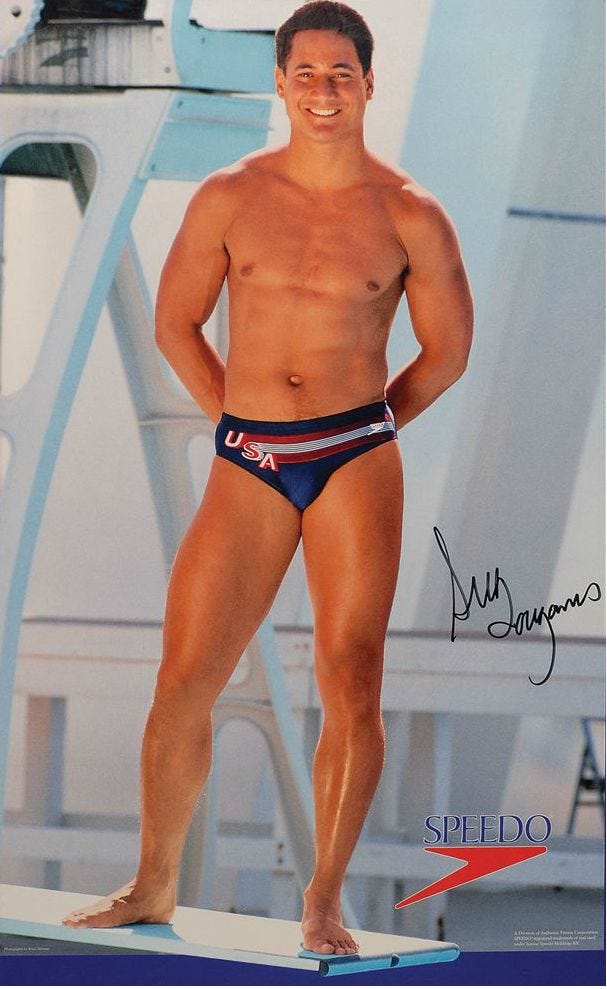
Louganis was my ultimate hero. He won pretty much everything for a decade. In Seoul, in 1988, he was defending his two golds from LA ’84, and I was just old enough to grasp the drama of the event. I recorded it on Betamax. I watched the competition everyday after school through my next season. I coveted the Air Mail service Speedo Louganis wore. I wanted to be my hero, in skill and in dress.
What most people remember about Louganis is that he struck his head during the meet and bled into the pool. They remember that he came back and won. They remember that, sometime later, he learned he was HIV-positive. In the 1980s and early 90s, that diagnosis, and Louganis’ sexuality, was enough for some folks to totally dismiss his achievements. And then, because of this dismissal, I learned more about my hero and his challenges: dyslexia, taunting, sexual abuse. I’d learned about courage watching him fly. I learned more about courage watching his vulnerability; watching him bare his soul, slowly sharing his full being. I learned then what it really was to be a superhero. It is one thing to fly from a springboard or platform. It is another to fly against the turbulence of public opinion. My challenges differ from Louganis’ challenges. Nevertheless, I found, and still find, inspiration in my superhero’s strength.
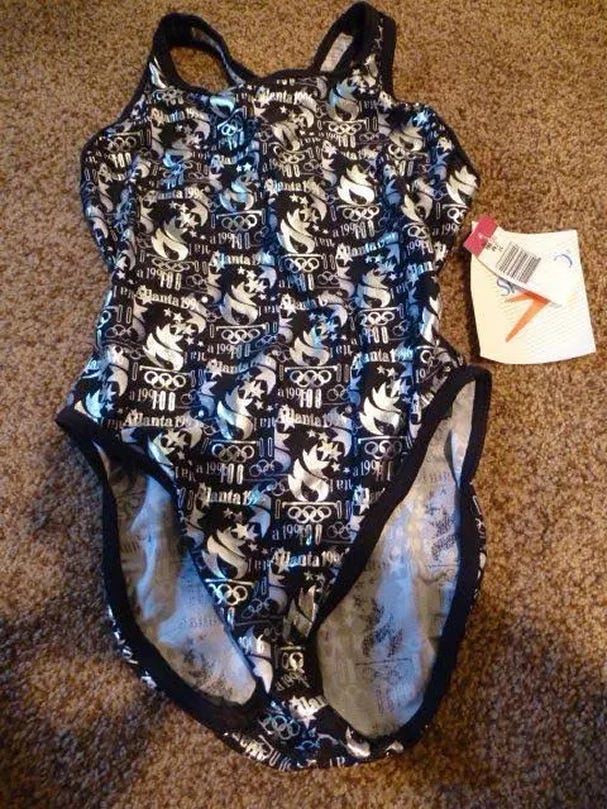
Entering high school, the elusive Air Mail Speedo never surfaced, but I did find a black and silver ’96 Atlanta design in a discount bin at a swim store in Newington, Connecticut. That was the suit I wore my senior season. The season I hyperextended my back on a 203c, a back 1 ½ somersault in the tuck position, during the first meet and basically missed the whole competitive schedule.
I thought of Louganis when I was allowed, by some grace, to compete at the New England championships. He bounced back from injury, and so could I. (Note: I did not however perform to Louganis’ standards). I thought of Louganis when I grappled with alcoholism in 2006, choosing to become sober and facing ridicule from friends for it. He’d been vulnerable, and so could I. I thought of Louganis when I accepted a bipolar diagnosis. He’d overcome mental health difficulties, and so could I.
Something I’ve considered is healing over time. I was born 20 years after Louganis, but still lived in a time of similar prejudices. Shedding stereotypes and pushing strongly against the status quo takes time. Healing oneself takes discipline and dedication. Diving in, paradoxically, wasn’t Louganis’ approach. Instead, he taught patience where emergence arrives when one is prepared for it.
Superheroes are always more than they appear. Superheroes inspire widely. Superheroes inspire individual growth. Superheroes inspire us to reach for the stars. Superheroes inspire societal change.
I tell whoever will listen that to watch the British champion Tom Daley knit by the pool deck is to know that he stands on the shoulders of Greg Louganis. I see his legacy when I watch athletes in the WNBA and on football pitches across the world now openly celebrate their partners. And when I watch NBA players paint their fingernails without fear of rebuke. I’ll now tell whoever will listen that to watch Keely Hodgkinson return from injury and smash world records is to know that she stands on the shoulders of Greg Louganis.
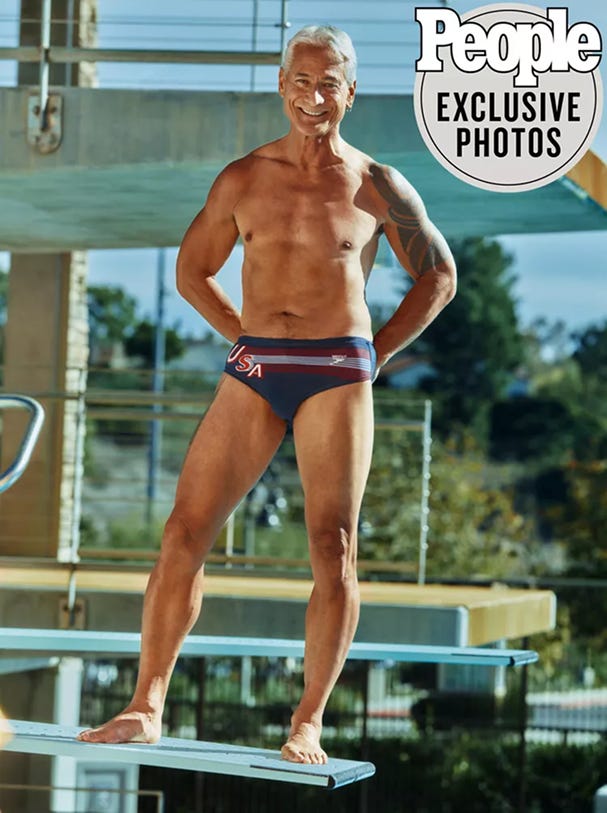
In the 2020s, all my heroes still wear briefs.
Nick Schonberger lives in Philadelphia.