

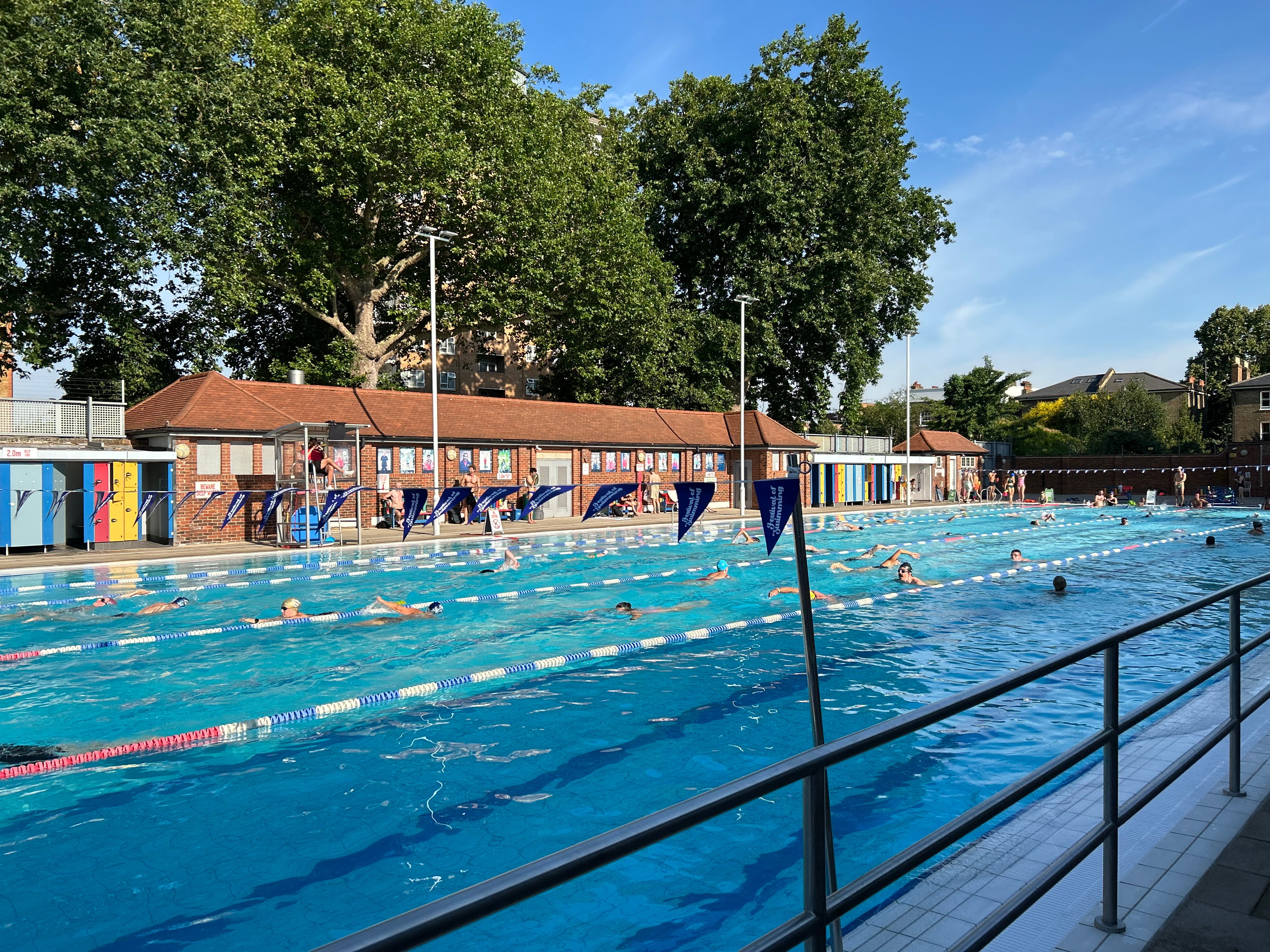
There are squares of tile in blue. A black line down the middle that is too often, unnervingly, not in the middle, but slightly to the left, or to the right. There is the general flotsam discharged from people in motion, like snot and plasters and hair and nails. The taste of chlorine that miraculously, like Starbucks, tastes the same wherever I go. There are the tiles at the end that require touching before turning.
But other than those things, there’s not much else. I should add that my goggles tend to leak in water. I am not sure what to do about this. I tried replacing them but each new one keeps on leaking. And I’ve tried adjusting them between lengths, but I don’t really know how best to do this and, in fact—as this essay slips into the confessional—I do not find the ends of lanes very hospitable, or at least not as hospitable as the water itself, so I tend to not break between laps when I swim, which I do in the summertime at the outdoor pool close to my flat. I swim, sometimes with water in my eyes, sometimes without, not for very long, a few times a week.
I used to be quite sporty. That distilled in me a competitive streak that requires years of unlearning, a journey which I am still on, but it means, for instance, that in this household Strava is banned, and if there’s an opportunity to finish early or just do a few less laps than usual and have a latte instead, my inner life coach supports it. There is an interesting thread to this. My body, of course, is changing. My lung capacity is shrinking and my arms are not what they used to be. But the mind, which is bitter and jealous and mean, has not caught up. It still considers the body that it rattles inside to be that of a 16 year-old bound by promise and hope. This results, despite the anti-competitive training regime, in me being regularly frustrated when overtaken. I tell myself there is a beauty in this, duh—in being ultimately the same child-self with adult-body. Like, life is immense, but ultimately I am the same person who placed first in year 6 regional breastroke.
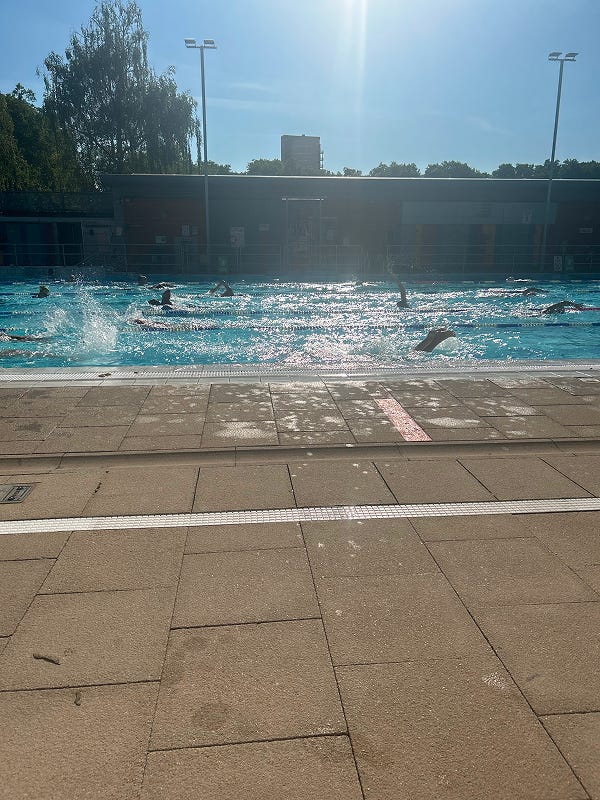
There are videos on YouTube that are really helpful to correct swimming techniques. I stumbled upon them after looking for a video that I remembered from my childhood, which is of athletes in high school practicing swimming fast by being chased by small alligators. This is a real video and a fascinating insight into the competitive mind and absolutely insane behaviour of high school coaches. But that video led me to better videos. And those videos taught me a new way to kick with my legs. I used to think that I needed to kick with my legs all the time, non-stop, like a car engine, but in fact this is not very à la mode in swimming. I now practice what is called a 2-beat leg stroke, which involves one kick per arm stroke, kicking with the opposite leg to the arm, like scissors. It is difficult to get the action right and, like rubbing your tummy and patting your head, it works best when I don’t think too much about it. There are also different theories about the action of arms. When I grew up, I used a high arcing elbow. This makes for a smooth entry of the arm into the water. I now prefer a longer, straighter arm that reaches forward, like it is trying to grasp at the water in front of me or scoop it up as if catching a goldfish. A fellow swimmer once told me between laps that I was doing great but that my left arm did not finish its stroke in the same manner as my right arm, and that this resulted in my technique being unbalanced. Lacking a mirror, I have never checked this, but I have also never managed to shrug the thought that he was correct. It worries me.
I focus on my breathing too. I practice, lap after lap, holding my breath for longer and feeling the strain on my lungs increase. I normally start with breathing every four strokes of front crawl. And then this becomes every six strokes. And sometimes every eight. This is partly meditative—like holding your breath in yoga, and partly pop-CBT—like holding your breath at work. But it is also some third thing to do with death, and life, and breathing in between; something—I’m not sure—about the thinness of life that I can feel when absorbed by concentrating and swimming without air. It is very peaceful.
In A Rushed Account of the Dew, Alice Oswald writes:
I who can hear the last three seconds in my head
but the present is beyond me
listen
I mentioned to my mum, who sings and likes to swim too, my theory about swimming: that the focus on a physical act—arms and legs and breath—creates an inner stillness. Perhaps, I suggested, the same could be said of playing music. I remember practising scales and focusing on the sound and resonance of the application of hand and bow to string, feeling drawn away in that action from everything outside of my life, from anything that wasn’t to do with the sound of the cello. It matches the concentration I need in swimming. And there is a closeness too between breathing in water and the playing of music: both outbursts of energy from a body or instrument. Mum was less convinced. She said maybe but she has now taught herself to think and sing at the same time. So what I am saying may not have a general application. It may apply only to swimmers who are not that good.
It is so hard, now, in the attention-slop economy, to be absorbed by anything, particularly something that I am doing myself, rather than something that is being done to me. I like swimming because it offers me that. A solitude in breathing and kicking and pulling with my arms. Occasionally, (I am not perfect) I will look at the people who swim past me and think about what they are doing with their body, which is different to my body, and why they are rolling their shoulders like that or what it says about them to be someone who kicks like that (so anxious, so needy). But most of the time, I look at the tiles on the floor. I have the taste of chlorine in my mouth. There is nothing like it.
Thea McLachlan is a writer living in London.